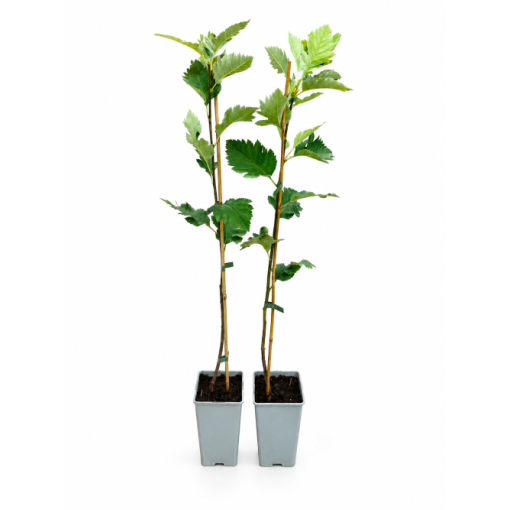
Swedish Whitebeam (Sorbus intermedia)
Swedish Whitebeam (Sorbus intermedia) is an exceptionally ornamental and easy-to-grow deciduous tree that provides year-round interest. In spring, it is covered with clusters of white flowers, while in summer it develops a dense crown of attractive silvery-green leaves. In autumn, the foliage turns beautiful shades of yellow and gold, complemented by decorative orange-red berries. During winter, the berries remain on the branches, providing an attractive display and an important food source for birds. Thanks to its excellent resistance to frost, drought, wind, and urban pollution, Swedish Whitebeam is widely planted in both private gardens and public landscapes.
What Does Swedish Whitebeam Look Like?
Swedish Whitebeam typically grows 10–12 metres tall and 5–7 metres wide. When young, it forms a regular, conical crown that gradually develops into a broad, rounded canopy with age. The tree has a moderate growth rate, allowing it to maintain an attractive shape for many years.
Its distinctive oval leaves are shallowly lobed and covered underneath with a silvery-grey felt-like coating, giving the tree an elegant appearance. In autumn, the foliage turns vibrant shades of yellow and golden orange.
In May, numerous white flowers appear in broad clusters, attracting bees and other beneficial pollinators. Decorative round berries ripen in autumn, turning bright orange-red and often remaining on the tree long after the leaves have fallen.
Are the Fruits Edible?
Yes. The fruits of Swedish Whitebeam are edible and rich in vitamin C and sorbitol, a naturally sweet sugar alcohol. Unlike the berries of the Common Rowan (Sorbus aucuparia), they have a much milder, less bitter flavour. They can be used to prepare jams, juices, syrups, liqueurs, and preserves. The berries are also an important food source for birds throughout autumn and winter.
Growing Requirements
Swedish Whitebeam is one of the easiest ornamental trees to cultivate. It performs equally well in private gardens and urban environments.
It grows best in:
full sun or light partial shade,
fertile, well-drained, moderately moist soils,
neutral to slightly alkaline soil.
The tree is highly resistant to:
frost,
temporary drought,
strong winds,
air pollution,
road salt and saline soils.
Its excellent hardiness means it is rarely affected by pests or diseases.
Planting and Care
The best time to plant Swedish Whitebeam is spring or autumn. Since it eventually becomes a fairly large tree, adequate distance from buildings and other mature trees should be maintained.
Maintenance is minimal:
water young trees regularly during the first few years after planting,
apply a balanced fertiliser for deciduous trees in spring if necessary,
prune only dead, damaged, or diseased branches, preferably in late winter.
Once established, mature trees require very little maintenance.
Uses in the Garden
Swedish Whitebeam is ideal as:
a specimen tree on lawns,
an avenue or street tree,
part of larger landscape designs,
an ornamental feature in parks and urban green spaces.
Its dense canopy provides pleasant shade during summer, while the colourful autumn berries attract many bird species, helping to increase biodiversity. It combines beautifully with cherry laurels, hollies, ornamental grasses, and flowering shrubs.
Interesting Fact
In Poland, natural populations of Swedish Whitebeam occur mainly along the Baltic coast in the Pomeranian region, where the species is strictly protected. However, nursery-grown plants offered for sale are legally propagated and are perfectly suitable for planting in gardens.