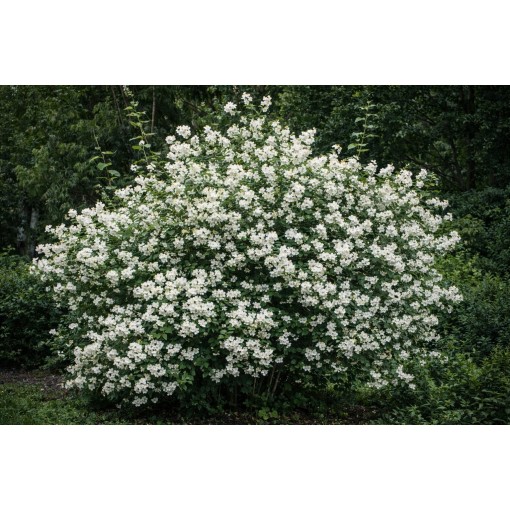
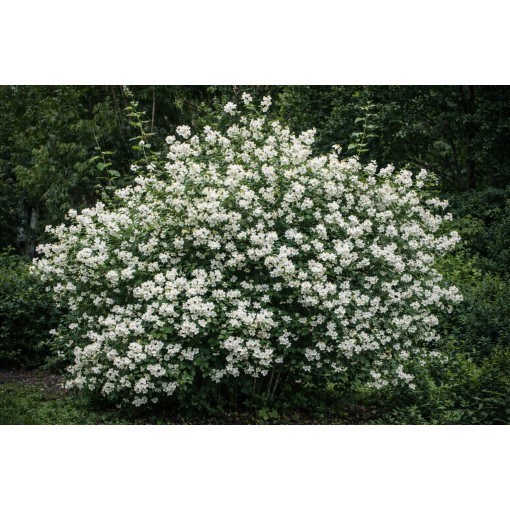
The Mont Blanc mock orange is a compact and highly ornamental variety bred at the end of the 19th century by the renowned French horticulturist Victor Lemoine. Its small size makes it an excellent choice for small gardens, borders and fragrant plant compositions.
The shrub forms stiff, upright shoots that are softly hairy when young. As it matures, the bark becomes brown and slightly peeling, giving the plant decorative value even outside the flowering season. It reaches about 1 m in height and width, often developing a natural, slightly rounded shape.
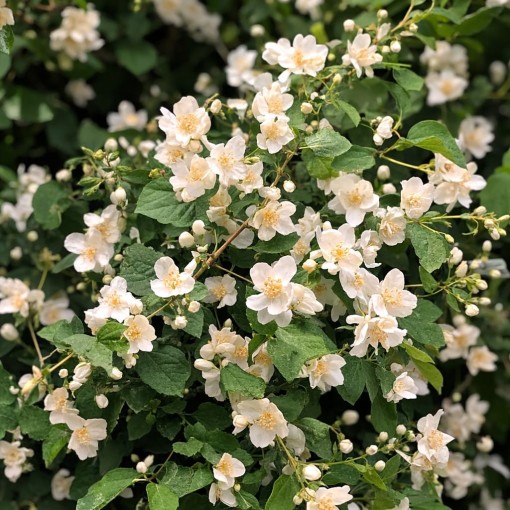
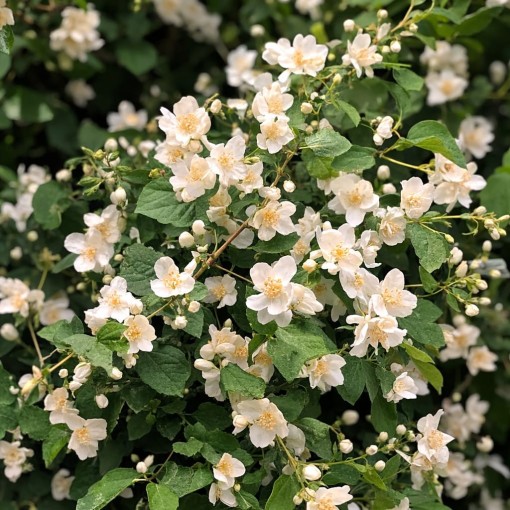
The dark green, elliptical leaves (2–3 cm long) are entire or slightly toothed and create an elegant backdrop for the flowers.
The blooms appear from late June to July. They are white, single, four-petaled and about 2.5 cm in diameter. Gathered in small clusters, they release a pleasant, distinct fragrance that attracts insects and fills the garden with a delicate scent.
The Mont Blanc variety is easy to grow and performs well in average garden soils. It prefers fertile, clayey, well-drained substrates with a neutral or alkaline pH. It flowers best in sunny or semi-shaded locations. The shrub is fully frost-hardy and resistant to drought and urban pollution.
Every few years, it is worth performing a rejuvenating prune right after flowering. This encourages new growth and ensures abundant blooming in the following seasons.
Mont Blanc mock orange looks beautiful as a solitary plant, in low hedges, on borders and in scented gardens. Its compact size and strongly fragrant flowers make it ideal for small spaces.