
- New
Clearance Up to 30% Off
An ornamental shrub originating from East Asia with a rigid and upright habit. The target height of the variety is 3 meters, but in Polish conditions, it reaches about 1.5 meters. It is a slow-growing shrub. The variety, exceptionally easy to cultivate and low-maintenance, deserves to be called a no-care shrub. Like most members of the species, the 'Maike' Syrian hibiscus is not very frost-resistant and requires winter protection. It blooms very abundantly at the turn of summer and autumn. The large pink-red flowers are the main ornament of the shrub. It prefers a warm, sunny, wind-sheltered position. The hibiscus must be watered regularly, as it does not tolerate drying out. The soil should be fertile, well-drained, moderately moist, with a neutral or slightly alkaline pH.
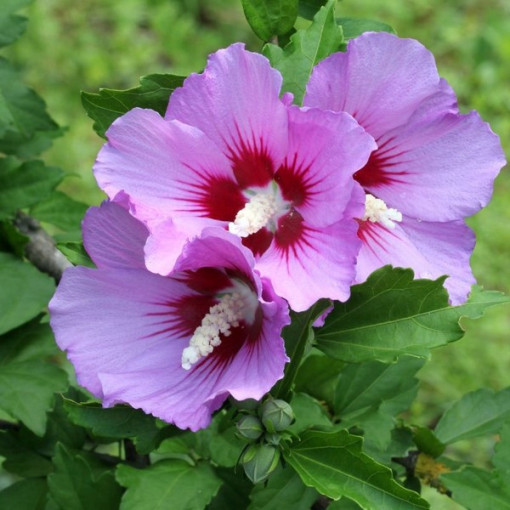
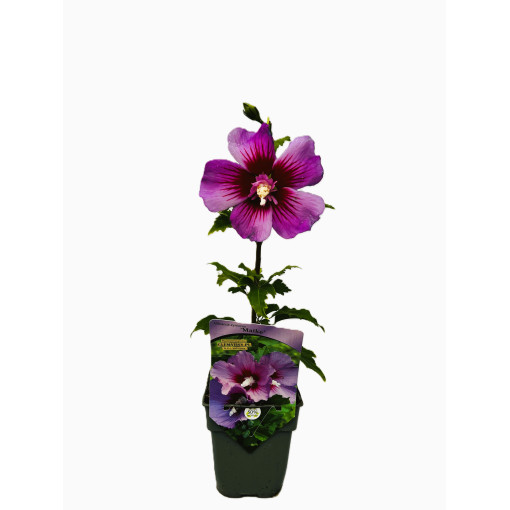
Flowering – the Maike hibiscus blooms very abundantly from August to September. The flowers consist of five large petals, with numerous smaller, elongated petals growing in the center. They are dark pink in color with a characteristic hibiscus eye in the inner part of the large petals. In the 'Maike' variety, these spots are red. The 3-lobed, coarsely serrated leaves are also decorative. In spring and summer, they are dark green, turning yellow in autumn, and falling off in winter.
Ripening and fruiting – not applicable
Conditions and requirements – for growing the 'Maike' Syrian hibiscus, it is best to choose a sunny, warm, and wind-sheltered location. It grows well in fertile, humus-rich, and well-drained soil, with a pH ranging from slightly acidic to alkaline. The shrub requires a moderately moist position. If planted in poor soils, the shrub blooms very poorly.
Care – the shrub requires constant but moderate watering. During dry periods, brown spots may appear on the leaves. The 'Maike' Syrian hibiscus is a slow-growing variety, so it does not require pruning. It is recommended to carry out rejuvenating pruning in March or April, removing old shoots. The Syrian hibiscus is a heat-loving plant and not very frost-resistant. Therefore, in winter, the shrub needs to be covered. Young shrubs are particularly vulnerable to freezing. To protect the plant, a mound should be built at the base of the shrub, consisting of dry leaves or needles, and soil should be piled up to a height of about 30 cm. During the flowering period, it is recommended to fertilize the shrubs, preferably with organic fertilizers.
Use – due to its abundant, long blooming period and, above all, beautiful flowers, the 'Maike' Syrian hibiscus is best planted in prominent places in gardens and parks. It is also suitable as a potted plant, making it perfect for decorating balconies and terraces.
It looks impressive when planted alone or in groups with other plants. It is successfully used as an untrimmed hedge.