
- Not Available
Clearance Up to 30% Off
This is a relatively young variety originating from Germany. It is a cross between two new varieties: Helfersteiner (Spätburgunder x Trollinger) and Heroldrebe (Portugieser x Lemberger). The vine has very strong growth, with upright shoot habits and a loosely organized structure. Even the one-year-old canes are thick and stiff, with open and hairy ends. It reaches a height of about 3-5 meters. The juice of the fruits of this variety is very dark, making it ideal for producing well-colored, heavier red wines. The variety is resistant to most diseases. It also has higher soil requirements and poor resistance to low temperatures. It prefers a sunny and warm position, sheltered from cold and strong winds. The best soil for grapes is fertile, sandy-loamy, and slightly moist.
Blooming: The vine blooms early, making it susceptible to the last spring frosts, which may cause it to freeze. The flowers are small, light yellow. The leaves are large, five-lobed, dark green. In autumn, they become a great decoration of the shrub, gradually changing to yellow-orange, then red and even purple. They beautifully contrast with the dark, almost black clusters.
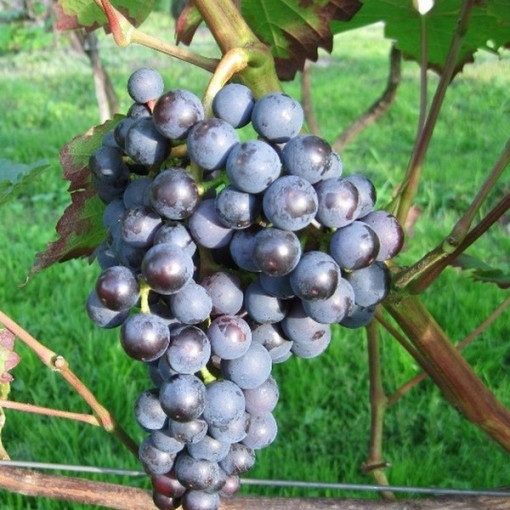
Ripening and fruiting: The fruit is dark garnet, with a heavy waxy coating, round, and collected in very large conical clusters weighing up to over 0.5 kg. This is due to large berries weighing 3-5 g. The Dornfelder variety stands out for its dark juice. This is quite rare, as usually, the flesh and juice of red varieties are white, and the dark color comes from the skins. Late harvesting is recommended, ideally from mid-October, when the fruits are fully ripe. Then the wines will be of excellent quality, balanced, and will have fresh fruity notes.
Growing conditions and requirements: The Dornfelder variety requires fertile, permeable, deep soils. It is very sensitive to both soil drying and excess moisture. The soil should be neutral to alkaline. The best positions for the shrub are partially shaded places. If planted in sunny spots, it requires regular watering.
Care: The shrub does not have special requirements for training, but the trunk should be tall enough to prevent the large clusters from touching the ground. It produces well with medium pruning to 3-5 buds and long pruning to 3-8 buds. Unfortunately, the first 2 buds, counting from the base of the cane, often do not set clusters, or the fruiting is very weak.
This variety has poor frost resistance and may require winter covering or protection of the base of the shrub in some regions of Poland.
Uses: The fruit of the Dornfelder variety is used to make dark wines with a velvety texture, often with hints of dark fruits such as plums, blackberries, cherries, or blueberries. Sometimes, they have a slightly floral aroma. These wines are usually aged in oak barrels. In the bouquet and taste, nutty aromas can also be detected. Dornfelder wine is considered one of the healthiest due to its high content of substances that help prevent high blood pressure.