
Clearance Up to 30% Off
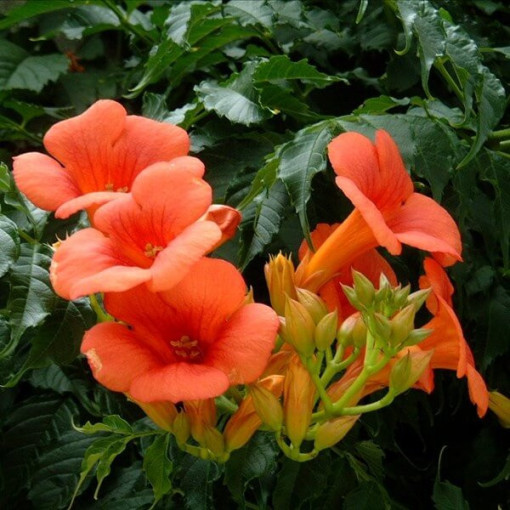
A species of ornamental climbing plant originating from the United States (southeastern states). In Poland, it is cultivated only as a crop plant. It grows up to 10 meters in length. Thick, weakly twining shoots, which attach themselves to walls and rocks using numerous adventitious roots. It has attractive trumpet-shaped flowers, 6-8 cm in length. These develop from July to September. The fruit of the trumpet vine is an unattractive hanging elongated capsule. It grows best in warm, sunny, and wind-protected locations. It prefers moderately fertile, well-drained soils with a neutral pH. The plant is not fully frost-resistant, but if it freezes, it regenerates easily.
A species of ornamental climbing plant originating from the United States (southeastern states). In Poland, it is cultivated only as a crop plant. It grows up to 10 meters in length. Thick, slightly twining shoots, which attach themselves to walls and rocks using numerous adventitious roots. The leaves are large, up to 30 cm, odd-pinnate, serrated, and dark green. The fruit, although it strongly resembles young bean pods, is actually a capsule, reaching up to 12 cm in length. The capsule is sharply pointed at both ends, and along two seams (two carpels), it is constricted, creating distinct ridges. The walls are hard and heavily woody, with rare lenticels in small depressions that resemble eyes (the lenticel openings look like pupils). The capsule is divided in half by a partition, initially quite thick and fleshy. The seeds are two-parted, flat, and winged. They are arranged in a row, one after the other, and multiple layers of wings cover the seeds. When ripe, the capsules turn brown, dry, and split, and the mature seeds are dispersed by the wind (in Poland, trumpet vine is propagated in cultivation by layering). They germinate after winter, as they require stratification. The presence of fruit has been noted in Szczecin, Wrocław, Opole, and other western parts of Poland. It is unknown which species is responsible for pollinating the flowers (in nature, pollination is mainly carried out by hummingbirds).
Uses: It is ideal for cultivation near pergolas, walls, fences, and other strong supports. It can reach a height of up to 10 m. The trumpet vine is resistant to diseases, pests, and frosts. Even if the stems freeze in a harsh winter, new ones will quickly grow from the base of the vine in the spring.
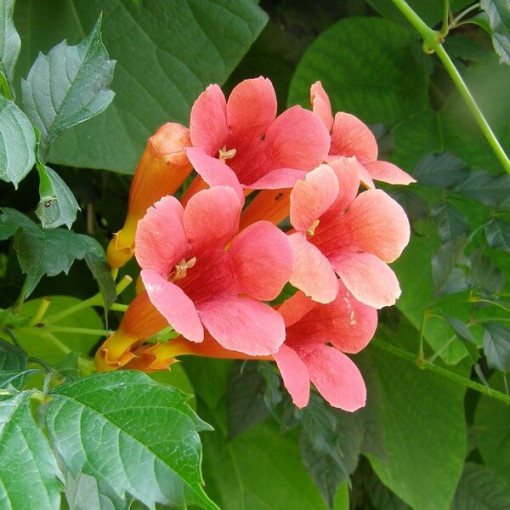
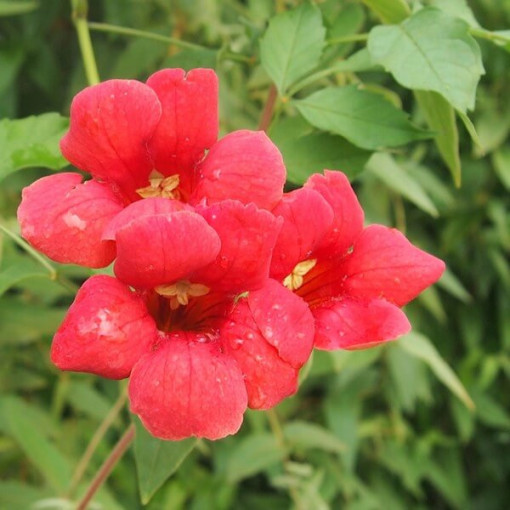
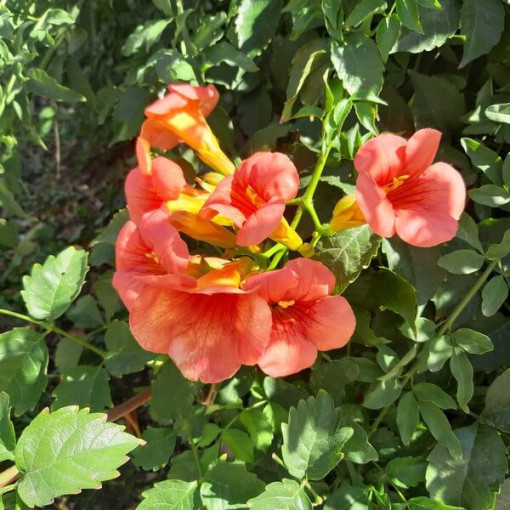
Flowering: From July to September. The flowers are tubular, trumpet-shaped, 6-9 cm long, and orange in color.
Requirements: It requires a sunny position, well-drained soil with a neutral, slightly acidic, or slightly alkaline pH.
Care: The trumpet vine begins its vegetative period relatively late, making it quite resistant to frost. In early July, the leaves intensively develop, creating a green bush. When fruits (long, several-centimeter-long pods) appear, it is a good idea to remove them to prolong the flowering period. Every year, in late March or early April, we prune the young shoots above the 2-3rd node (a few buds) above the main shoot. Damaged and weak shoots are completely cut out, or we leave only one node at the base. Strong pruning enhances flowering and strengthens the base of the plant.