
Clearance Up to 30% Off
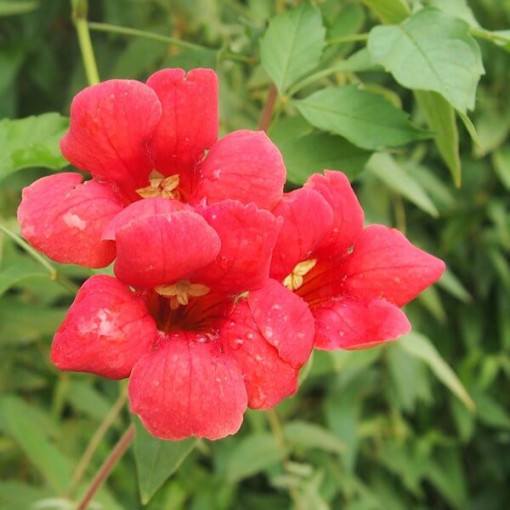
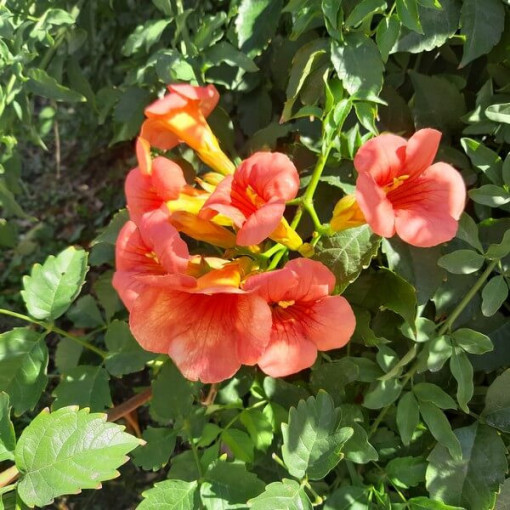
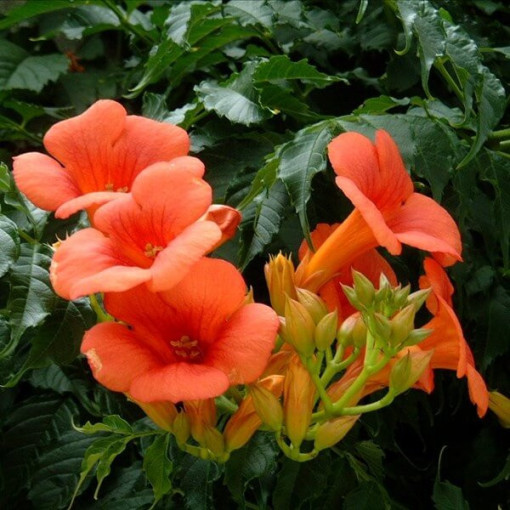
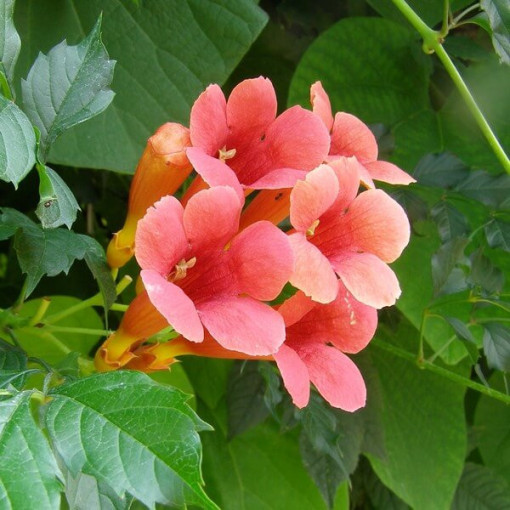
A species of ornamental climbing plant native to the United States (southeastern states). In Poland, it is only grown as a cultivated plant. It grows up to 10 meters in length. The thick, weakly twisting stems attach to walls and rocks with numerous adventitious roots. It has attractive trumpet-shaped flowers, 6-8 cm long. They bloom from July to September. The fruit of the trumpet vine is an unattractive hanging, elongated capsule. It grows best in warm, sunny, and wind-protected locations. It prefers moderately fertile, well-drained soil with a neutral pH. The plant is not fully frost-resistant, but if it freezes, it easily regenerates.
A species of ornamental climbing plant native to the United States (southeastern states). In Poland, it is only grown as a cultivated plant. It grows up to 10 meters in length. The thick, weakly twisting stems attach to walls and rocks with numerous adventitious roots. The leaves are large, up to 30 cm, pinnately compound, serrated, dark green. The fruit, although strongly resembling young broad bean pods, is actually a capsule that reaches up to 12 cm in length. The capsule is sharply pointed at both ends and compressed along two seams (two fruiting bodies), forming distinct edges. The walls are hard and heavily woody with sparse pores in small depressions resembling eyes (the pore hole looks like a pupil). The capsule is divided in half by a septum, initially quite thick and fleshy. The seeds are bipartite, flat, and winged. They are arranged in a row, one after another, and are repeatedly covered by the wings of subsequent seeds. Mature capsules turn brown, dry out, and burst open, and mature seeds are dispersed by the wind (in our region, trumpet vine is propagated by layering). They germinate after winter because they require stratification. Fruit presence has been recorded in Szczecin, Wrocław, Opole, and thus in the western part of Poland. It is unknown which species is responsible for pollinating the flowers in our region (in nature, pollination is mainly done by hummingbirds).
Uses: Perfect for cultivation on pergolas, walls, low walls, and other strong supports. It can reach a height of up to 10 meters. Trumpet vine is resistant to diseases, pests, and frost. Even when the stems freeze in harsh winters, new shoots quickly emerge from the base of the vine in spring.
Flowering: From July to September. The flowers are fused-petaled, trumpet-shaped, 6-9 cm long, orange in color.
Requirements: It requires a sunny location, well-drained soil with a neutral, slightly acidic, or slightly alkaline pH.
Care: Trumpet vine starts its vegetative period relatively late, making it quite resistant to frost. In early July, the leaves intensively develop, creating a green bush. When fruits (long, several centimeters long pods) appear, it is advisable to remove them to prolong the blooming period. Every year, at the turn of March and April, cut the young shoots above the 2-3rd node (a couple of buds) above the main stem. Cut out the damaged and weak shoots completely or leave only one node at the base. Strong pruning strengthens flowering and the base of the plant.