
- Not Available
Clearance Up to 30% Off
In nature, sea buckthorn grows mainly along sea coasts and in river valleys of Europe and Asia. In Poland, it grows wild only along the Baltic Sea coast, where it is a protected species. The leaves of sea buckthorn evaporate large amounts of moisture. This shrub is resistant to air pollution and does not require heavy watering. It prefers warm, sunny, or semi-shaded positions. It grows in almost any type of soil but prefers loose, sandy soil with an alkaline pH and high calcium and phosphorus content.
In nature, sea buckthorn grows mainly along sea coasts and in river valleys of Europe and Asia. In Poland, it grows wild only along the Baltic Sea coast, where it is a protected species. The leaves of sea buckthorn evaporate large amounts of moisture. The fruits are a natural cosmetic used by the women of Siberia and Tibet, who make anti-wrinkle masks from the crushed berries. It is frost-resistant.
Use: It is a deciduous shrub that sheds its leaves in winter. Mature, healthy specimens can reach 3 to 3.5 meters in height. Its bushy, stiff shoots in the early stages of growth are equipped with sharp thorns. Sea buckthorn fruits can be processed into juices, jams, and jellies. It is worth it — they have remarkable properties. Sea buckthorn is one of the few plants whose fruit pulp contains about 10% fatty oil. In addition, it is rich in trace elements and vitamins B, K, P, E, and C, as well as folic acid, provitamin A, and D. Importantly, the vitamin C in sea buckthorn does not break down during processing or storage.
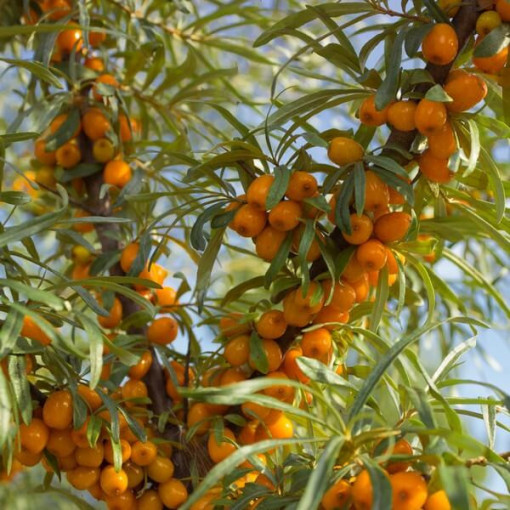
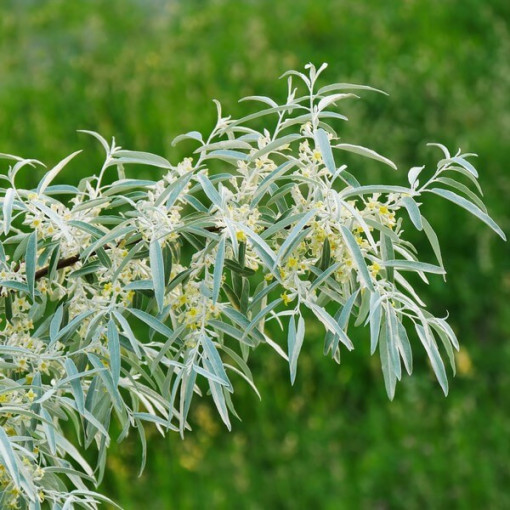
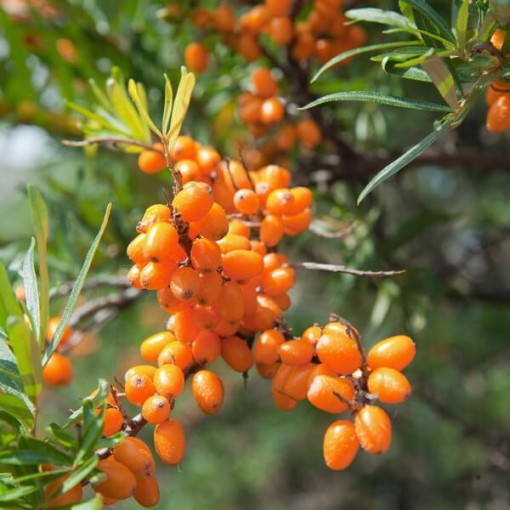
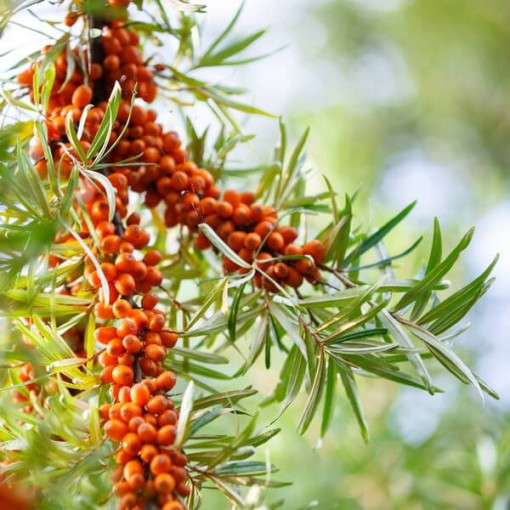
Flowering and fruiting: Flowers appear in March–April, before the leaves. Sea buckthorn is a dioecious plant – female plants (with yellow flowers that produce fruit) and male plants (with yellow-green flowers producing pollen for fertilization) grow separately. The shrub produces decorative, edible fruits that turn orange when ripe. The berries remain on the shrub throughout the winter season until the new growing period begins. One male tree is enough to pollinate up to five female trees. Fresh fruits are difficult to pick as they are firmly attached to the stems and quite sour. To make harvesting easier, whole branches are cut, divided into parts, leaves removed, and frozen. Once removed from the freezer, the fruits are quickly separated from the twigs.
Care: A plant that loves sunlight. After planting, sea buckthorn should be watered frequently! It needs space and dislikes the proximity of other plants, especially when young. Ideal conditions are a wide circle around the shrubs covered with compost and mulch. After planting, it requires almost no maintenance. It is highly resistant to low temperatures and summer drought. It grows in almost any soil but prefers loose, sandy soil with an alkaline pH and high calcium and phosphorus content. Sea buckthorn seedlings can be planted in early autumn. Keep a distance of 1–2 meters between shrubs.
Pruning: Sea buckthorn shrubs do not require pruning, only the removal of dry shoots.