
Clearance Up to 30% Off
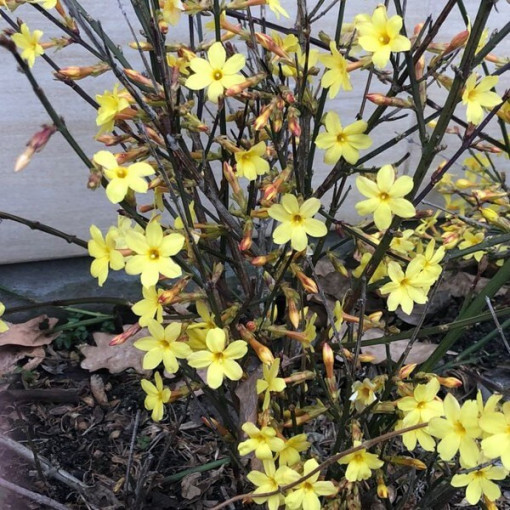
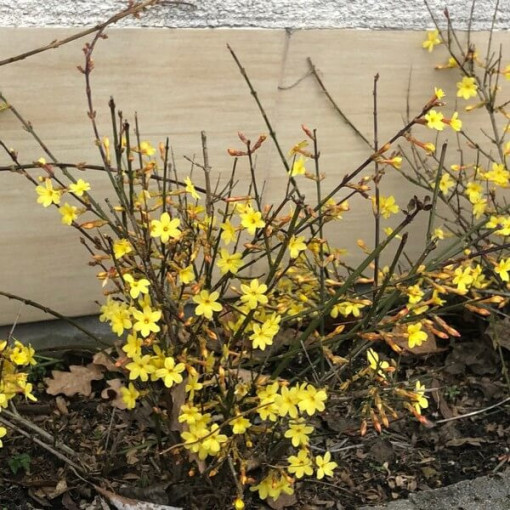
This is a winter delight with golden flowers. Jasmine is a little-known but extremely attractive shrub or ornamental vine. When grown on supports as a vine, it can reach a height of about 4m. Its stems do not wrap around other plants. As a shrub, it grows up to 1.5m. It blooms at a very unusual time, in WINTER, from February to March. It prefers a sunny, warm location, sheltered from cold and strong winds. It is frost-resistant, making it ideal for our climate conditions. It prefers fertile soil.
This is a winter frenzy with golden flowers. Jasmine is a little-known yet extremely attractive ornamental shrub or vine. When grown on supports as a vine, it can reach a height of about 4m. When treated as a shrub, it grows up to 1.5m. It blooms at a very unusual time – IN WINTER. It originates from northern China. The plant has small but fragrant flowers.
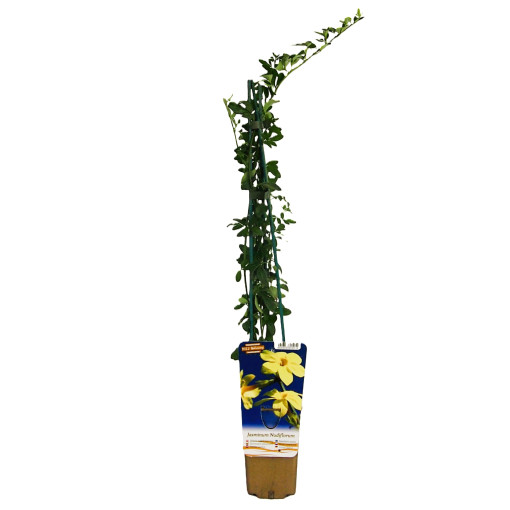
Usage: It is a plant suitable for covering walls, posts, decorative trellises, or pergolas. It is also suitable as a low shrub that grows freely. The freely hanging stems are a wonderful decoration for stairs, handrails, or balustrades, and also create a beautiful and fragrant entrance to the house. It is perfect for all types of containers. Jasmine can also be treated as a trailing plant. If planted on a slope or wall, it will cascade down, particularly impressive during the blooming period.
Blooming: It blooms in winter, for a very long time. The first small, golden-yellow tubular flowers appear on the shrubs at the end of October, and blooming gradually continues until the end of April, with breaks during freezing periods. The flowers are spaced singly along the length of the pliable, thin, and leafless stems. The flowers are not very large, but they release a pleasant fragrance. During blooming, jasmine can be combined with early spring plants like hellebores or laurustinus planted under the shrub. After blooming, the plant produces dark green, shiny, trifoliate, very ornamental leaves that last throughout the season and fall off before winter. The stems can be freely shaped into picturesque garlands.
Care: Jasmine does not produce climbing organs, so it must be tied up to climb. It requires a sunny, warm, sheltered position. The soil should be well-drained, fertile, rather dry, with a neutral or alkaline pH. Jasmine is sensitive to severe frosts. In winter, it should be protected by covering the base of the shrub with leaves, and the stems with straw or mats.
Pruning: Stems with flower buds can be cut in winter and brought indoors, where they will bloom. Prune the stems to half their length just after blooming. This will encourage branching and more abundant blooming.