
- Not Available
Clearance Up to 30% Off
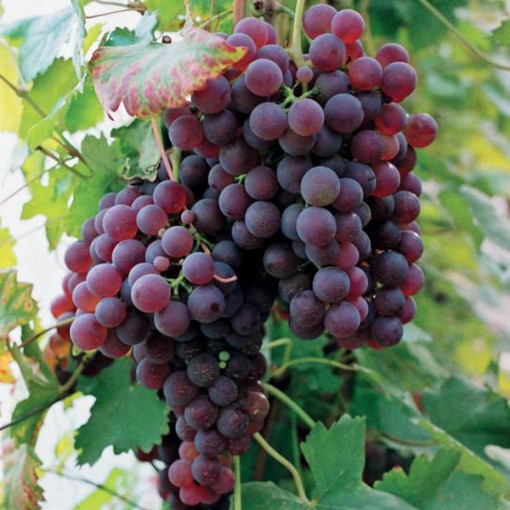
The Suffolk Red grapevine is an interspecific hybrid developed in the USA. It is an early dessert variety with pink-purple, partially seedless fruit. The vertical vine can grow up to 6 meters in height and width. Easy to cultivate, low-maintenance, with good resistance to diseases and pests, and high frost resistance. The shrub grows moderately or quickly, depending on the site. The small, sweet fruit with a dominant strawberry aroma is suitable for both wine and desserts. It prefers a warm, sunny location sheltered from strong, cold winds. The best soil for grapes is fertile, sandy-clay, and slightly moist.
Flowering: an early-flowering variety (from late May to early June). The flowers, gathered in grape-like clusters 15-20 cm long, are inconspicuous, small, and light yellow in color. Almost invisible against the large leaves. Leaves are slightly rounded, medium-sized or large, green on top and gray-green and fuzzy underneath, with three wide lobes. Petioles are yellow-green.
Ripening and fruiting: the "Suffolk Red" variety is classified as an early-ripening grapevine. The fruits can be harvested in the first half of September.
Spherical, medium-sized berries are set on clusters up to 20 cm long. A characteristic feature of this variety’s fruits is the almost complete absence of seeds. Some fruits may contain one or two soft seeds that are unnoticeable when eating.
The berries have very thin, soft, pink-purple skin, and their flesh is juicy and sweet. Young Suffolk Red bushes produce golden berries with a light pink blush.
Growing conditions and requirements: the Suffolk Red grapevine should be planted in sunny or semi-shaded locations sheltered from the wind. In full sun, the plant will grow quickly, bloom profusely, and, most importantly, bear abundant fruit. In overly shaded areas, it may become more susceptible to diseases. The variety is fairly tolerant of soil types but grows best in sandy-clay soils, moderately moist, with a slightly alkaline pH.
Care: the shrub does not have significant requirements regarding its growth form. Thus, it can be successfully shaped into a low head, cordons, or pergolas. When the first fruits appear, it is recommended to cut new shoots a few centimeters above the grapes. From mid-summer, leaves directly above the fruits can also be removed. These activities aim to expose the ripening fruits to direct sunlight. Regular pruning helps control the growth of the shrub and promotes the production of high-quality fruits. In autumn, fallen leaves beneath the shrub should be systematically removed as they provide an ideal environment for diseases and mites that may attack the plant.
The Suffolk Red variety may require intensive watering in spring during its growth phase. Later, additional irrigation may be needed in summer during dry periods. Like most grapevines, this variety is highly frost-resistant. It can withstand temperatures below -24°C.
Applications: the Suffolk Red vine can reach up to 6 meters in length, making it suitable for large fences and tall pergolas. The fruits of this variety are perfect for red or rosé table wines. They can be eaten fresh or stored for extended periods. The wine has a strong aroma of red fruits, predominantly strawberries.