
- Not Available
Clearance Up to 30% Off
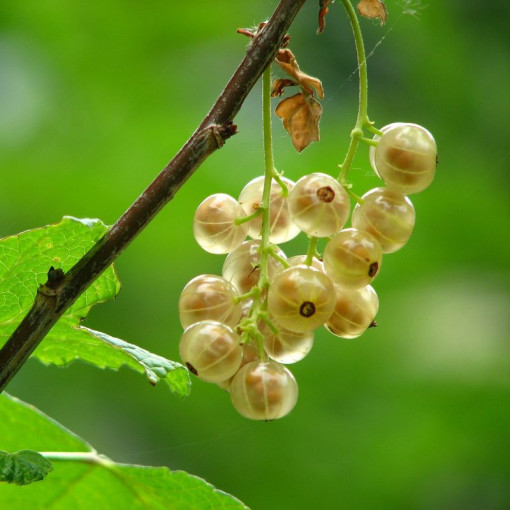
White currant bushes grow up to about 2 meters. White currant fruits contain a significant amount of vitamin C, PP, potassium, iron, fiber, sugar, and others. They taste sweet and sour, very delicate. This variety is frost-resistant.
White currant bushes grow up to about 2 meters. White currant fruits contain a large amount of vitamin C, PP, potassium, iron, fiber, sugar, and others. They have a sweet-sour taste and are very delicate. This variety is frost-resistant.
Uses: White currant fruits are suitable for direct consumption as well as for preserves, juices, liqueurs, jams, and jellies. White currants can also be grown in large pots or boxes.
Flowering and fruiting: It blooms in April. The flowers are inconspicuous, gathered in long clusters, pale yellow. The fruits are round, pale cream, and gathered in long clusters. They fruit from late July to August. White currant fruits are very healthy, rich in vitamin C, P, B vitamins, provitamin A, biotin, and folic acid.
Care: It requires fertile soils with a slightly acidic pH, it is good to fertilize it, pH 6.2-6.7.
Sunny positions. The bush should be planted deeper than it was in the pot. Young bushes should be planted
in autumn or early spring. Plant them 1-1.5m apart.
Pruning: After planting, cut the seedling back to 2-3 buds. This pruning will ensure that in the first year after planting, it will have 6-9 young shoots. In the following years, we "thin out" the bushes, preventing excessive thickening. White currant fruits mainly grow on short shoots, so it is important to promote the branching of the plant. The best fruits appear on the branched skeletal shoots of 2-, 3-, and 4-year-old branches. Therefore, do not cut one-year-old shoots, but old, 5- and 6-year-old ones. For the first 5 years after planting, we shorten one-year-old shoots by half their length. Twigs that excessively thicken the bush, cross each other, are weak, or lie on the ground should be completely removed. In the 6th year, in the 3rd month or after harvest, cut the oldest 5-year-old shoots, and leave the same number of one-year-olds, shortening them to encourage better branching. The bush should then have 3-4 one-, two-, three-, and four-year-old shoots. Maintaining this balance is the key to abundant yields.