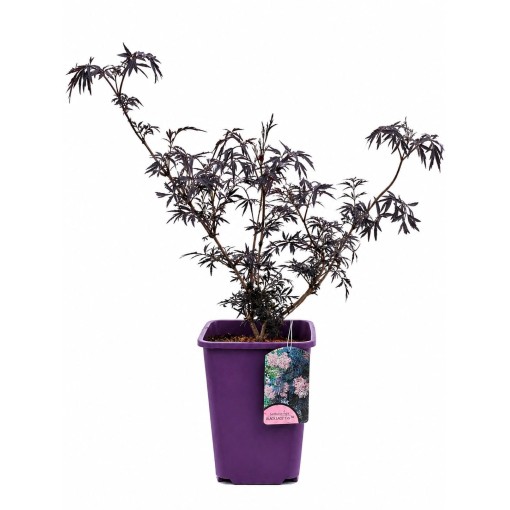
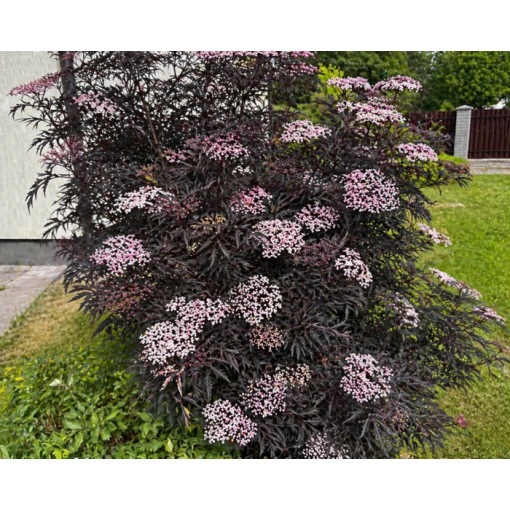
Black Elder ‘Black Lace’ is one of the most striking ornamental elderberry varieties, valued for its dark purple, deeply cut leaves that give the plant a light, lacy appearance. The shrub reaches 2–3 m in height and 1–2 m in width, forming an airy, elegant habit that works well both as a specimen plant and in larger garden compositions.
Foliage – dark, finely cut, with exceptional texture
The leaves are large, 20–30 cm long, composed of several oval leaflets with deep, often double serrations. Young leaves are intensely purple, while older ones turn greenish‑purple, retaining their shine and characteristic aroma when crushed. The finely cut structure gives the shrub a modern, lightweight look and creates a strong colour accent in plantings.
Inflorescences – pale pink umbels contrasting with dark foliage
At the turn of May and June, the plant produces pale pink, lightly fragrant flowers gathered in flat umbels 10–20 cm across. The bright flower clusters contrast beautifully with the dark leaves and attract pollinating insects, including butterflies. Flowering is not very abundant but highly ornamental.
Fruits – purple‑violet, juicy, eagerly eaten by birds
In September, small spherical berries about 5 mm in diameter ripen. They are glossy, purple‑violet and very juicy. Birds feed on them readily, helping the plant spread naturally. The fruits contain vitamins A, B and C as well as potassium, and can be used for preserves or as an ingredient in dishes.
Habit and growth
‘Black Lace’ forms a loose, spreading shrub with upright shoots. Young stems are purplish‑red, while older branches become thick, light grey and often arching. With age, the bark turns grey and deeply furrowed.
Growing requirements
Position: full sun; in partial shade the leaf colour is weaker.
Soil: fertile, humus‑rich, moist, high in nitrogen and calcium; grows more slowly in sandy soils.
Hardiness: fully frost‑resistant, tolerant of drought and urban or industrial pollution.
Care: undemanding; responds well to rejuvenation pruning.
Garden use
Black Elder ‘Black Lace’ is suitable for:
parks and public green spaces,
home gardens,
naturalistic plantings,
contrasting compositions with light‑coloured plants,
solitary plantings as a strong colour accent.