
Clearance Up to 30% Off
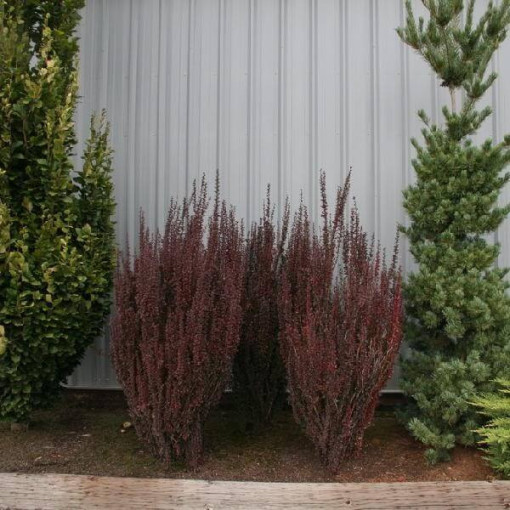
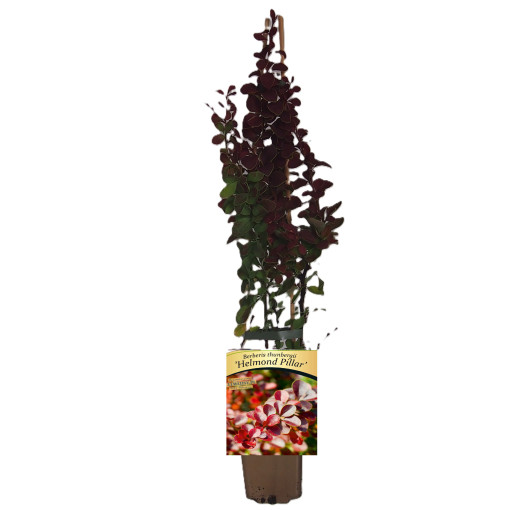
A slender, columnar shrub. It grows fairly quickly, with an annual growth of about 20 cm. It reaches a height of 1.5 m and a width of 0.4–0.6 m. Like all barberries, 'Helmond Pillar' is thorny. Its small, deciduous, deep purple, round-shaped leaves fall off for winter. Small yellow flowers appear in spring. Edible fruits appear in August and remain on the shrub throughout winter. This variety is fully frost-resistant and low-maintenance in terms of soil and location. Prefers warm, sunny, and semi-shaded positions. Grows well in acidic or moderately alkaline soil.
Flowering – 'Helmond Pillar' blooms yellow from May to June.
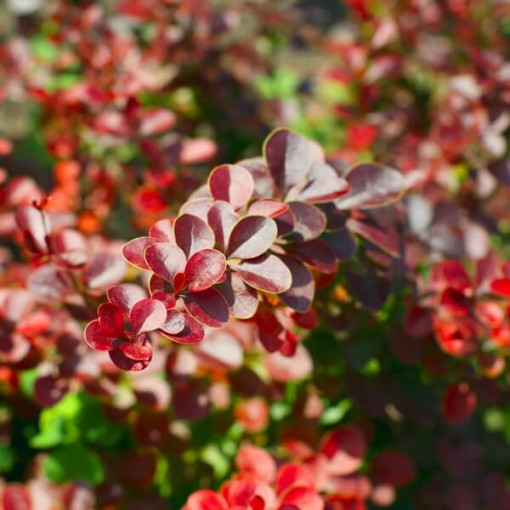
The leaves of this variety have one of the darkest shades among all barberries – deep purple. In autumn, the foliage turns bright scarlet. The thin shoots are covered with sharp thorns.
Ripening and fruiting – the shrub produces fruit between August and September. Small red berries, slightly oval-shaped, remain on the shrub even after all the leaves have fallen and persist throughout winter. The edible fruits are a delicacy for birds.
Growing conditions and requirements – Like other species in the genus, 'Helmond Pillar' is frost-resistant, low-maintenance, and very tolerant of different soil pH levels. However, it thrives best in sunny or semi-shaded positions, in fertile, humus-rich, and slightly moist soils.
Care – It is recommended to trim the tips of the shoots by about 5 cm at least twice a year. These cuts help shape and strengthen the plant. The first trimming should be done right after winter to remove dried or broken branches; the second one in summer. Every few years, rejuvenation pruning can be done to remove the oldest shoots and stimulate strong regrowth. 'Helmond Pillar' is frost-hardy and sheds its leaves for the winter. When handling barberries, remember to wear protective gloves due to their sharp thorns.
Use – Thanks to its shape, 'Helmond Pillar' pairs well with most shrubs and perennials. It is suitable for both formal and informal hedges. Due to its low requirements and high resistance, it is frequently used in urban greenery.
It can serve as a lasting, colorful element of a changing flower bed.
The unusual columnar habit of this variety adds elegance to planting compositions.
Barberries have a compact root system, making them excellent container plants.